
What Is Eustachian Tube Dysfunction?
If your ears feel clogged, muffled, or full and the sensation simply won't clear, you may be dealing with Eustachian Tube Dysfunction (ETD), a frequent concern at the Dr. Monica Tadros Center for Sinus, Sleep, & Facial Plastic Surgery. ETD occurs when the narrow tube connecting your middle ear to the back of your throat fails to open, close, or drain properly. The result is impaired pressure regulation and trapped fluid behind the eardrum.
Your eustachian tubes have two essential jobs: equalizing air pressure between the middle ear and the outside world, and draining mucus from the middle ear into the throat. When that mechanism stalls, you may feel ear fullness, popping or clicking, muffled hearing, and mild ear pain. Some patients also notice a sensation that their own voice sounds louder inside their head.
ETD is common and usually treatable. On this page, you'll find a clear breakdown of symptoms, underlying causes, at-home remedies, in-office treatments, and the signs that warrant evaluation by a dual board-certified ENT and facial plastic surgeon in our New York and Englewood locations.

What Are the Symptoms, Causes & Types of Eustachian Tube Dysfunction?
The hallmark signs of ETD typically include ear fullness, popping or clicking sounds, muffled hearing, tinnitus, mild ear pain, and occasional balance problems. Causes range from allergies and upper respiratory infections to sinusitis, altitude shifts, acid reflux, and anatomical blockages like a nasal septum deviation. There are two main types: obstructive ETD and patulous ETD.
Common Symptoms to Watch For
- Ear fullness or pressure that doesn't resolve with swallowing
- Popping, clicking, or crackling sounds when you yawn or chew
- Muffled or dampened hearing, as if you're underwater
- Tinnitus (ringing, buzzing, or humming in the ear)
- Mild ear pain or discomfort, especially with pressure changes
- Balance disturbances or a sensation of dizziness
- Autophony, hearing your own voice or breathing unusually loudly
What Causes Eustachian Tube Dysfunction?
The eustachian tubes are sensitive to anything that inflames or obstructs the upper airway. The most frequent triggers include:
- Allergies and chronic rhinitis that cause swelling around the tube opening
- Colds and upper respiratory infections that produce excess mucus
- Sinusitis with persistent inflammation and post-nasal drainage
- Altitude changes during flying, diving, or driving through mountains
- GERD (acid reflux) irritating the nasopharyngeal tissues
- Anatomical blockages including nasal polyps, enlarged adenoids, or a deviated septum
- Smoking and secondhand smoke exposure
Two Types of ETD
| Type | What Happens | Typical Sensations |
|---|---|---|
| Obstructive ETD | The tube stays closed and cannot open to equalize pressure | Fullness, muffled hearing, popping, pain with altitude changes |
| Patulous ETD | The tube stays open when it should be closed | Autophony, breathing sounds in the ear, voice echo |
Obstructive ETD is far more common and is what most patients describe when they report "clogged ears" that won't clear. Because the two types feel similar yet call for different treatment, a careful in-office assessment is the most reliable way to tell them apart and chart the right path forward.
Risk Factors and When Symptoms Warrant Evaluation
You may be more susceptible to recurrent ETD if you have chronic sinusitis, nasal polyps, a nasal septum deviation with a crooked nose, untreated allergies, or a history of smoking. Children are also more prone to ETD because their eustachian tubes are shorter and more horizontal than an adult's. Occasional ear popping after a flight is normal, but persistent symptoms are not. You should schedule an evaluation at our New York or Englewood office if ear fullness, muffled hearing, or pressure lasts longer than two weeks, recurs frequently, or comes with significant pain, drainage, or hearing loss. Left untreated, chronic ETD can lead to recurrent middle ear infections, eardrum retraction, fluid accumulation, and even permanent hearing changes.
Diagnosis & Remedies: From Home Care to In-Office Treatment
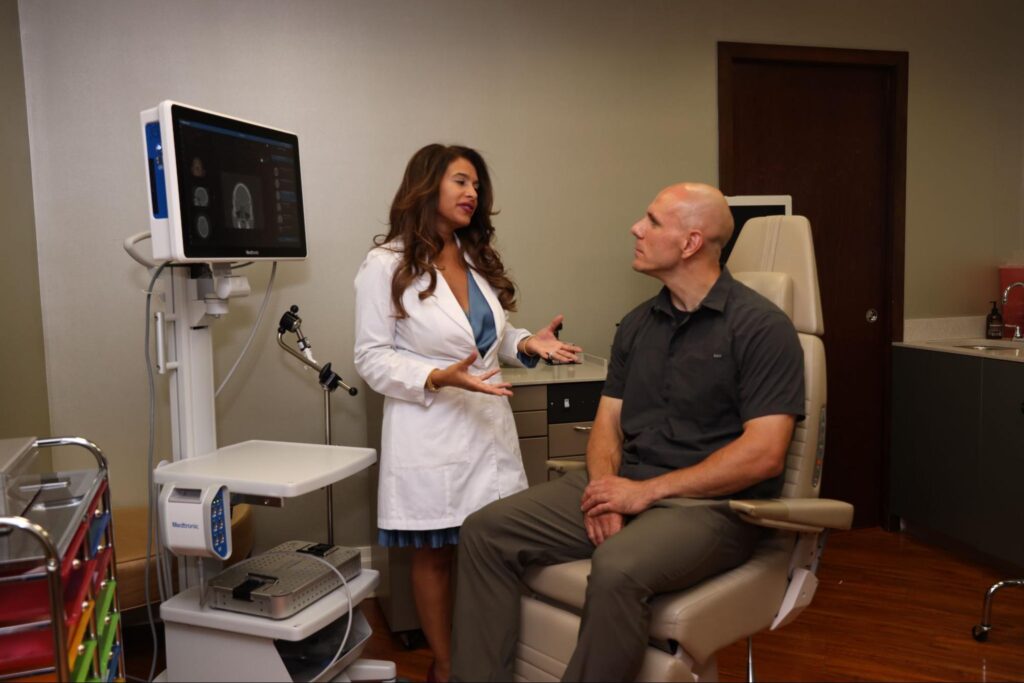
Diagnosing Eustachian Tube Dysfunction starts with a focused ENT exam. That includes otoscopy to view the eardrum, tympanometry to measure middle ear pressure, and nasal endoscopy to evaluate the tube opening and surrounding anatomy. Remedies range from simple home maneuvers and nasal sprays to in-office balloon eustachian tuboplasty and surgical correction of contributing nasal or sinus disease.
How ETD Is Diagnosed
At the Dr. Monica Tadros Center for Sinus, Sleep, & Facial Plastic Surgery, your evaluation typically includes:
- Detailed history of your symptoms, triggers, and prior ear or sinus issues
- Otoscopy to visualize the eardrum for retraction, fluid, or scarring
- Tympanometry to measure how well the eardrum moves and detect pressure abnormalities
- Hearing test (audiometry) if hearing changes are present
- Nasal endoscopy to inspect the eustachian tube openings, adenoid tissue, septum, and sinuses
Pinpointing the exact source of your symptoms is what allows Dr. Tadros to tell whether your ETD is an isolated ear issue or rooted in a sinus or structural problem, so your treatment targets the real cause rather than just the discomfort.
Home Remedies You Can Try First
For mild or short-lived symptoms, several techniques can help open the tubes:
- Swallowing, yawning, or chewing gum to activate the muscles that open the tube
- The Valsalva maneuver, gently exhaling with your nose pinched and mouth closed
- The Toynbee maneuver, swallowing while pinching your nose
- Steam inhalation or warm compresses to thin mucus and reduce congestion
- Saline nasal sprays or rinses to flush irritants and allergens
- Over-the-counter decongestants or antihistamines for short-term relief during a cold or allergy flare
If your symptoms persist beyond a couple of weeks, home remedies alone are unlikely to resolve the underlying problem.
Medical Treatment Options
When home care isn't enough, medical management focuses on reducing inflammation and treating root causes:
- Prescription nasal steroid sprays to shrink swollen tissue around the tube opening
- Allergy management, including immunotherapy when allergies are a recurring trigger
- Treatment of sinusitis with targeted medications
- Reflux management if GERD is contributing to upper airway irritation
In-Office and Surgical Remedies
For chronic or recurrent ETD, advanced options offered at our New York and Englewood locations include:
- Balloon Eustachian Tuboplasty, a minimally invasive procedure where a small balloon is inflated inside the tube to restore normal opening and drainage
- Ear tube (tympanostomy tube) placement to ventilate the middle ear and drain trapped fluid
- Balloon Sinuplasty to open blocked sinuses that are fueling chronic inflammation
- Deviated Septum Surgery (septoplasty) to correct a nasal septum deviation with a crooked nose contributing to airway obstruction
- Turbinate reduction to address chronic nasal swelling
- Nasal polyp removal when polyps are blocking drainage
Why Addressing the Nasal and Sinus Root Cause Matters
Recurrent ETD is rarely an isolated ear problem. The nose, sinuses, and eustachian tubes share the same drainage pathway, so chronic sinus or nasal obstruction often keeps ETD coming back. Treating the upstream cause, whether that's chronic sinusitis, septal deviation, or polyps, is often the key to lasting relief. As Dr. Tadros frequently reminds patients, the nose is an organ and needs to work properly in addition to complementing the features of your face, and the same principle applies to the connected ear and sinus system.
Frequently Asked Questions About Eustachian Tube Dysfunction
How long does Eustachian Tube Dysfunction last?
Most cases tied to a cold, allergy flare, or altitude change resolve within a few days to two weeks as the underlying inflammation subsides. ETD is considered chronic when symptoms last longer than three months or keep returning. Chronic cases usually point to an underlying sinus, allergy, or anatomical issue that needs targeted evaluation by a distinguished ENT.
How do you unclog eustachian tubes fast at home?
Start with swallowing, yawning, or chewing gum to activate the muscles that open the tube. The Valsalva maneuver, gently blowing with your nose pinched and mouth closed, can also help equalize pressure. Saline sprays, warm steam, and a short course of an over-the-counter decongestant may provide additional relief if congestion is a factor.
Can ETD go away on its own?
Yes, mild or acute ETD often resolves on its own once the trigger (a cold, allergy flare, or flight) passes. Persistent or recurrent symptoms typically require professional evaluation because they signal a deeper cause that won't self-correct.
When should I see an ENT for ear pressure?
Schedule an evaluation if ear pressure or fullness lasts longer than two weeks, returns repeatedly, or comes with hearing loss, significant pain, drainage, dizziness, or tinnitus. Early assessment can prevent complications like chronic middle ear fluid, eardrum retraction, and hearing changes.
Does flying make Eustachian Tube Dysfunction worse?
Flying frequently triggers or worsens ETD because of rapid cabin pressure changes during takeoff and landing. Using a decongestant before your flight, chewing gum, and performing the Valsalva maneuver can help. If you have chronic ETD, talk with Dr. Tadros about preventive options before air travel.
Is balloon Eustachian Tube dilation safe and effective?
Balloon eustachian tuboplasty is a minimally invasive, FDA-cleared procedure that has become a common option for adults with persistent obstructive ETD. Professional otolaryngology guidance indicates that balloon dilation can improve eustachian tube function and reduce symptoms in patients who have not responded to medical therapy. Recovery is typically quick, with most patients returning to normal activities within a day or two.
Related Conditions & Treatments We Address
Eustachian Tube Dysfunction often overlaps with other upper airway conditions we treat regularly, including:
- Chronic sinusitis that drives ongoing inflammation around the tube opening
- Nasal septum deviation with a crooked nose contributing to blocked drainage
- Nasal polyps obstructing airflow and mucus clearance
- Chronic rhinitis treated non-surgically with RhinAer
- Nasal obstruction addressed with VivAer
- Obstructive sleep apnea and sleep-disordered breathing linked to nasal congestion
Related treatments include Balloon Sinuplasty, turbinate reduction, nasal polyp removal, and septoplasty. Because the ear, nose, sinus, and throat function as one connected system, a thorough sinus and ear evaluation is often the most direct route to lasting relief.
Get Lasting Relief from Ear Pressure & ETD
If ear fullness, pressure, or muffled hearing has been lingering, you don't have to keep guessing at solutions. Dr. Monica Tadros is a dual board-certified ENT and facial plastic surgeon, M.D., with training from Columbia Presbyterian and Children's Hospital of New York and deep experience in diagnosing and treating the root causes of ETD. Both non-surgical and minimally invasive options are available at the Dr. Monica Tadros Center for Sinus, Sleep, & Facial Plastic Surgery. Our New York, NY and Englewood, NJ offices welcome patients across Manhattan and Northern New Jersey. Schedule a consultation or call 201-408-5430 to get started.